
Next.js Just Admitted Caching Was a Mistake
On the rare, uncomfortable, and quietly correct decision to reverse a foundational default years after shipping it.
Frameworks almost never admit they were wrong about something foundational. They add a flag. They add an escape hatch. They write a migration guide that uses the word "improved" fourteen times and never once says "we got this backwards." So it's worth pausing on what actually happened in Next.js 16, because underneath the changelog language, it's a genuinely rare event: the team looked at one of the framework's oldest, most load-bearing defaults, and reversed it.
The default in question is caching. And the reversal is bigger than a performance tweak — it's an admission that implicit behavior, however well-intentioned, becomes a liability the moment nobody in the room can hold it in their head anymore.
The old default: caching as a guessing game
For most of the App Router's life, caching in Next.js was aggressive and implicit. Whether a given route ended up static or dynamic depended on a tangle of route segment configs — dynamic, revalidate, fetchCache — combined with whatever a nested fetch() call happened to do internally, several component layers away from the file you were actually looking at.
You've felt the symptom even if you never diagnosed the cause: a page that stayed stale for reasons nobody could explain in the standup, or a route that suddenly went dynamic because someone three files away called cookies() inside a function that used to be pure. The behavior wasn't wrong, exactly. It was just invisible. You needed a working mental model of the entire caching heuristic just to predict what a single line of code would do, and that mental model lived in blog posts and GitHub issues, not in the code itself.
This is the classic shape of a "smart default." It optimizes for the demo — everything is fast out of the box, nobody has to think about it — at the direct cost of the thing that matters six months later: whether an engineer who didn't write the code can look at it and know what it does.
The new default: nothing is cached until you say so
Next.js 16 introduces Cache Components, and the mental model inversion is total. With the flag on, nothing is cached automatically. Every route, every component, every data access runs dynamically at request time unless you explicitly mark it otherwise.
// next.config.ts
import type { NextConfig } from 'next'

const nextConfig: NextConfig = {
  cacheComponents: true,
}

export default nextConfig
Turn that flag on, and route-level configs like dynamic, revalidate, and fetchCache stop working entirely — they error out, on purpose, forcing you to migrate to the new primitives rather than let old and new caching models coexist in a way nobody could reason about.
Caching now happens exactly where you'd expect to find it: inline, next to the code it affects, as an explicit directive.
async function getProducts() {
  'use cache'
  cacheLife('hours')
  cacheTag('products')

  const res = await fetch('https://api.example.com/products')
  return res.json()
}
cacheLife() sets how long the cached result stays fresh, using named profiles (seconds, minutes, hours, days, or your own custom ones) instead of a raw number buried in a config file. cacheTag() gives that cached entry a name you can invalidate on demand — after a mutation, you call revalidateTag('products') and the next request gets fresh data, deliberately, instead of waiting out a TTL or restarting the server.
There's a second directive worth sitting with: "use cache: private", for data that should be cached but is scoped to a single user's session rather than shared across everyone hitting the route. It's a small addition, but it closes a category of caching bug that used to be genuinely dangerous — the kind where user A's dashboard briefly renders with user B's data because a cache key didn't account for identity.

The part that actually matters: the framework stopped guessing quietly
Here's what makes this more than a config change. Under the old model, if your code accidentally did something that made a route dynamic when you expected it static, Next.js wouldn't tell you. It would just render differently than you thought, and you'd find out in production, or in a Lighthouse score, or in a Slack message asking why the pricing page feels slow today.
Cache Components changed the failure mode from silent to loud. In development, if a route reads uncached data outside a <Suspense> boundary, the framework doesn't render it and hope for the best — it stops, flags exactly which data access broke the route's ability to render instantly, and gives you three explicit choices: stream it behind a <Suspense> boundary, cache it with "use cache", or deliberately block on it with export const instant = false if waiting is actually the right call for that route.
That last option is worth noticing too, because it means the framework isn't claiming dynamic-by-default is always correct. It's saying: pick one, on purpose, and write it down where the next engineer can see it. The validation isn't there to shame you into caching everything. It's there to make sure that whatever you chose, you actually chose it.
This is, not coincidentally, the same argument for writing a design doc before you write the feature, or specifying a contract before you build against it. A framework that renders silently is a framework asking you to trust it. A framework that stops and asks you to decide is a framework asking you to specify. Those produce very different codebases at scale — one where behavior is discoverable by reading, and one where behavior is discoverable by debugging.
Why a framework reverses itself
It's worth asking why this took years, given that the pain of implicit caching was never exactly a secret. The honest answer is the same reason founding debt and technical debt both survive so long in the wild: the cost of the shortcut is invisible right up until the system is big enough for the shortcut to matter, and by then, reversing it is expensive.
Every app built on the old model had, in effect, memorized the guessing game. Teams built internal wikis explaining which combinations of fetch options and segment configs produced which caching behavior. That knowledge became a hidden dependency of the codebase — real, load-bearing, and completely absent from the code itself. Reversing the default doesn't just change new code going forward; it obsoletes a body of tribal knowledge that people spent real hours accumulating. That's precisely why frameworks so rarely do it. It's an admission that the complexity many teams had learned to route around was never necessary in the first place.
What makes Next.js's version of this reversal notable is that it didn't try to hide the blast radius. It didn't quietly change defaults and let people find out the hard way. It shipped the new model behind an explicit opt-in flag, made the old config options hard-error instead of silently misbehaving under the new model, and built a validator whose entire job is to make the invisible visible during migration. That's what taking a foundational reversal seriously actually looks like — not just fixing the design, but respecting how much cost the old design already put into the world.
The uncomfortable generalization
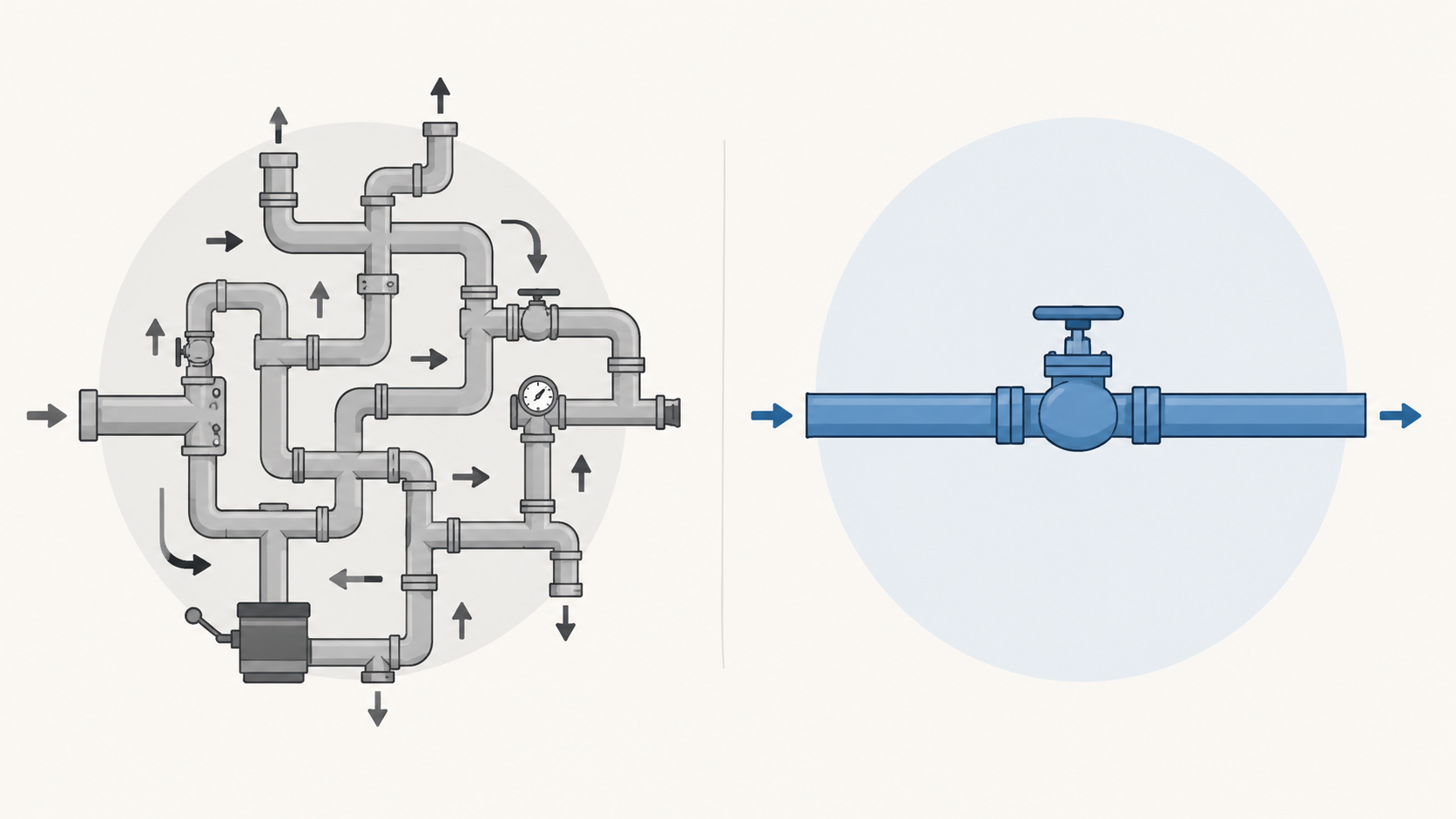
It's tempting to read this as a Next.js story. It's really a story about defaults in general, and how long a bad one can survive purely because it was never loud enough to force a reckoning.
Every system you maintain has at least one Cache Components–shaped problem in it right now — some early decision that optimized for looking effortless on day one, at the cost of becoming unreadable by day one thousand. It's rarely the big, documented architecture decisions that cause this. It's the small implicit ones: the config that "just works" until someone asks why, the behavior everyone on the original team understood without ever writing down, the smart default that was smart for exactly as long as the system stayed small enough for a human to keep the exception list in their head.
The lesson isn't "make everything explicit and pay the verbosity tax everywhere." Next.js didn't do that either — cacheLife profiles and tag-based invalidation are still there to keep the common cases short. The lesson is narrower and harder: implicit behavior is a loan, and like any loan, it's fine as long as you remember you took it out. The moment a team can no longer explain why something behaves the way it does, only that it does, the interest has quietly started compounding. Next.js just decided to pay its balance down in public, changelog and all.
Enjoyed this article?
Share it with others!
